The one-person bottleneck: when it's time to stop being the courier between your own tools
If you're the one retyping the same client details into your CRM, your invoicing tool, and a spreadsheet, that's not a time-management problem. Here's how to tell when it's worth automating, and when it genuinely isn't.
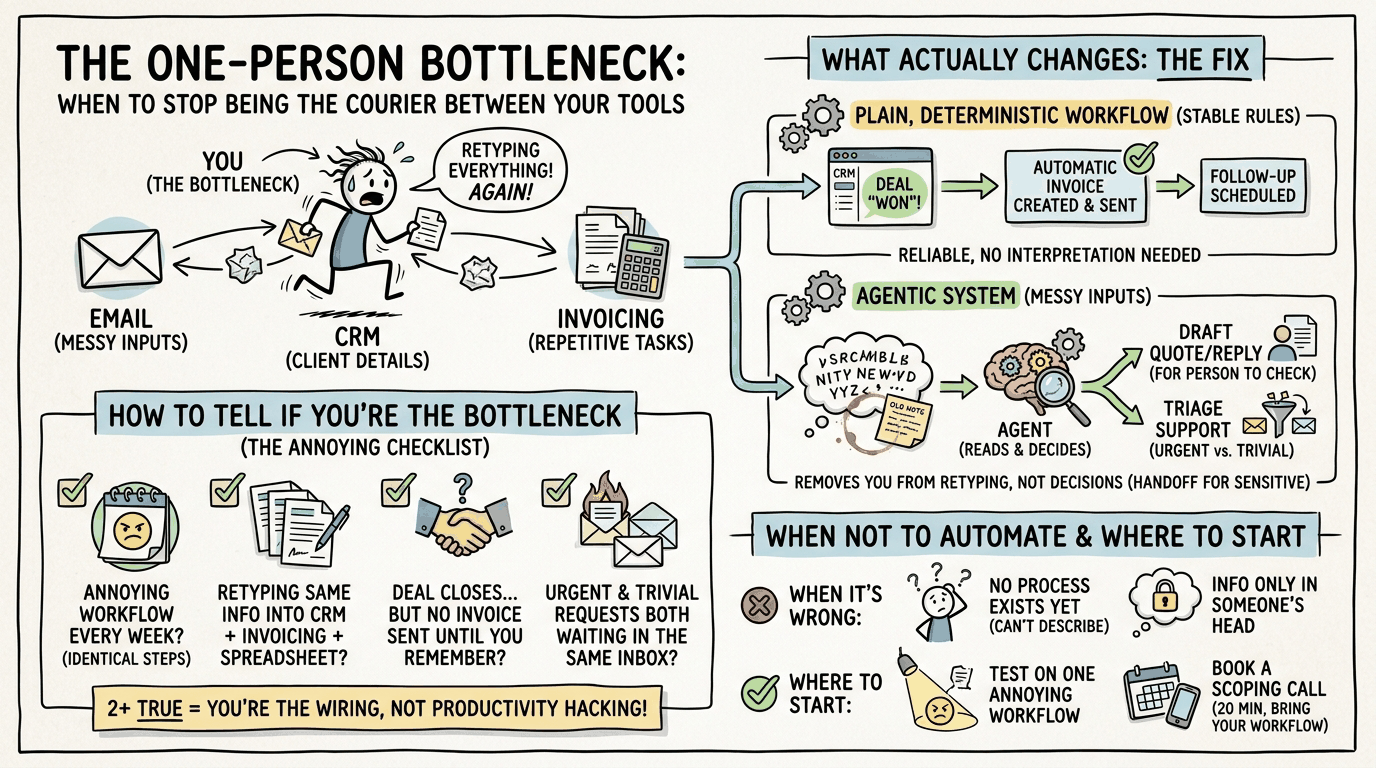
If you're the one who takes a client's details out of an email, types them into the CRM, then types them again into the invoicing tool, that's not a time-management problem. It's a structural one. The business is routing information through a person instead of between systems, and the person happens to be you.
Here's the pattern worth noticing: ChatGPT will draft the email. It won't open your CRM, find the file, check availability, or chase the invoice. Every one of those handoffs is a place where the work waits for you, and where a copy-paste error hides. An assistant that only writes doesn't close that gap. Something has to actually move the information, not just describe it.
How to tell if you're the bottleneck
A few honest questions, not a hypothetical:
- Can you name a workflow that annoys you, that happens every week, identically, and that you could describe start to finish without checking anything?
- Is client information typed into more than one tool by hand, the CRM and the invoicing tool and a spreadsheet, all carrying the same fact?
- When a deal closes, does someone have to remember to create the invoice, rather than the invoice simply existing because the deal closed?
- Does an urgent request sit in the same inbox as a trivial one, waiting its turn, while the person who sent it hears nothing?
If two or more of these are true, you're not missing a productivity hack. You're the wiring.
What actually changes
The fix isn't a single tool doing everything, and it isn't "add more AI" to the parts that are already working. Most real systems split the work in two:
Where the rule is stable and the input is structured, a plain, deterministic workflow does the job, reliably, without needing to consult a model at all. A deal marked "won" in the CRM should trigger the invoice, the send, and the follow-up schedule, every time, the same way. There's nothing to interpret.
Where the input is messy, an email, a set of field notes, a photo of a whiteboard, something has to read it and decide what it means before anything else can happen. That's where an agent earns its cost. Not because AI is impressive, but because the alternative is a person doing that reading by hand, at the exact moment they're also trying to do everything else.
The two halves working together is the actual pattern behind lead qualification that pulls the right product and drafts a reply for you to check, field notes that turn into a structured draft quote with the gaps flagged, and a support inbox that triages urgent from trivial before either one waits.
None of it is autonomous by design. Anything sensitive, a discount, a refund, a commitment to a client, escalates to a person before it happens. The point isn't to remove you from the decision. It's to remove you from the retyping.
Bring the one workflow that annoys you most
A scoping call is unpaid. Its only job is to find out whether that workflow is worth building, including when the honest answer is no.
ContactWhen this isn't the right move yet
This only works if the process itself is real. It's fair to walk away from automating something if:
- Nobody can describe the process end to end, because it doesn't actually have one yet
- The information that matters only exists in someone's head, or in a conversation that was never written down
- What you actually want is a system that decides on its own, with no one checking, on something that shouldn't be decided that way
Building a system on top of a process that doesn't exist just automates the confusion faster. Fix the process first, or accept that this particular workflow needs a person's judgment every time, not a system's.
Where to start
You don't need a strategy document to test this. You need one workflow: the one you could already describe in the questions above. A scoping call is unpaid, and its only job is to find out whether that one workflow is worth building or not, honestly, including the answer being no.
Read how the agentic systems service actually works, or contact me and bring the one workflow that annoys you most.
FAQ
How do I know if a workflow is worth automating, or if I should just live with it?
If it happens every week, follows the same steps each time, and you could describe it start to finish without checking anything, it's a strong candidate. If the steps change depending on who's involved or nobody agrees on how it's actually supposed to work, fix the process before automating it.
Can a small team automate operations without hiring an ops person?
Often, yes, for the specific workflows that are repetitive and well-defined. It replaces the retyping, not the judgment calls that still need a person. A single scoping call is usually enough to tell whether a given workflow fits that description.
Does this mean an AI is making decisions on its own?
No. Deterministic parts of the system run the same way every time because the rule is stable. Where an agent interprets something messy, like an email or a note, it hands off to a person before anything sensitive happens rather than deciding alone.
What if I only have one workflow that's a problem, not a whole broken process?
That's the ideal starting point, not a limitation. One concrete, working system is worth more than a broad plan that never ships.